History

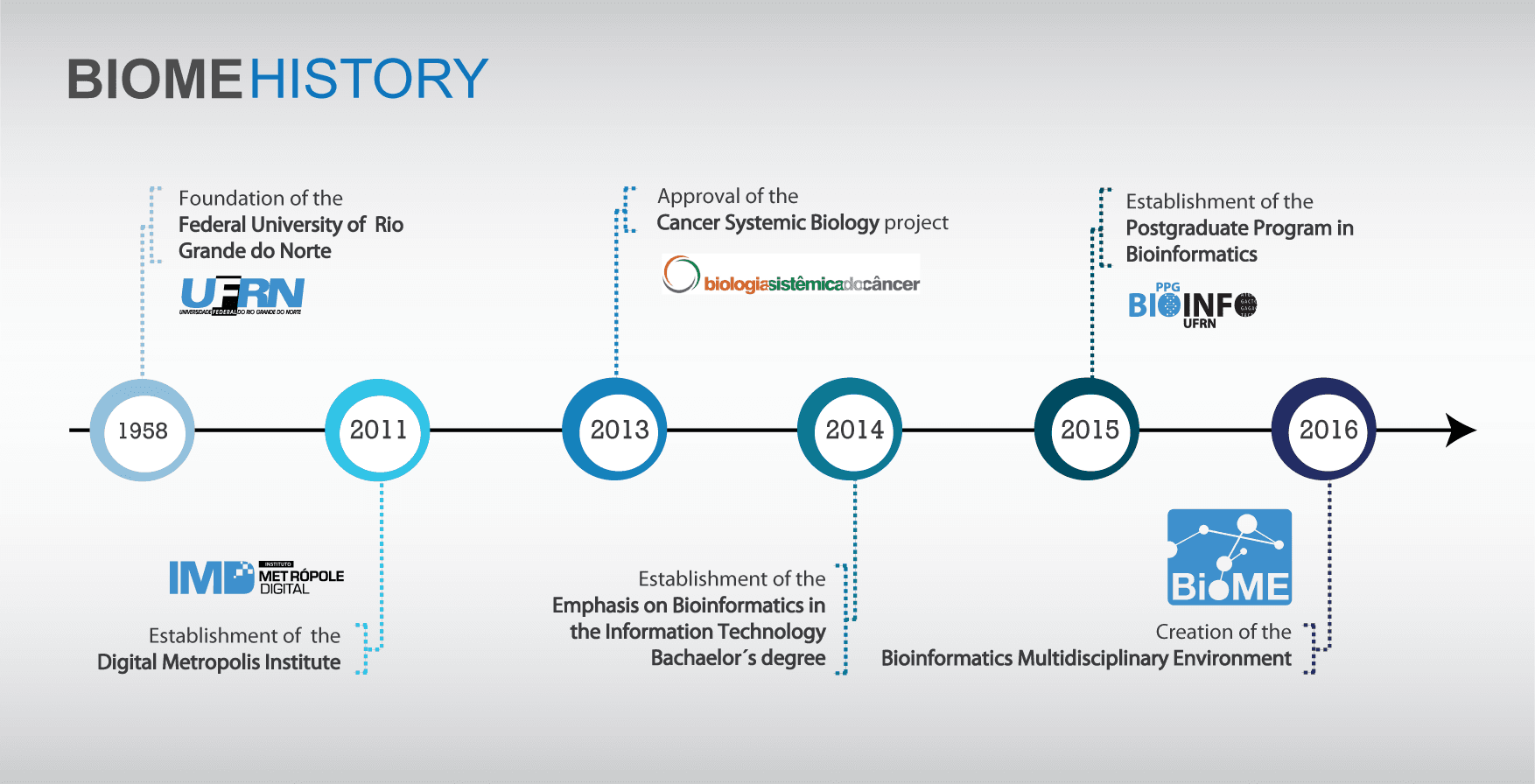
BioME is a bioinformatics initiative created in 2016 at UFRN, Natal - Brazil. However, the history of BioME is directly linked to UFRN's efforts to recruit important leaders with expertise in the field of Bioinformatics and training of personnel; in the establishment of the Digital Metropolis Institute (IMD) and its innovative model; and in the creation of the Postgraduate Program in Bioinformatics.
In 2011, the establishment of the Brain Institute (ICe) and IMD motivated the recruitment of group leaders working at the interface of computing and life sciences. Since then, IMD has been acting on the frontier of basic research and innovation, promoting a culture of entrepreneurship, as well as research and technological innovation. In 2012, Prof. Sandro José de Souza, one of the pioneers of the field in Brazil and with a history of success in training human resources in Bioinformatics, was recruited by the Brain Institute. More recently, four other bioinformaticians were recruited by UFRN. This group of newcomers joined other professors already established at UFRN who are exponents in their fields.
The approval of the 'Cancer Systemic Biology' (BSC) project under CAPES' Computational Biology call (051/2013) also contributed to defining bioinformatics as a priority within UFRN. The main objective of the BSC network is to promote computational and systems biology in Brazil. It is coordinated by Prof. Sandro J. de Souza and consists of twenty professors and researchers from UFRN, UFMG, USP, and the Antonio Prudente Foundation, as well as foreign researchers from the University of California San Diego, University of Heidelberg, and University of Oslo.
In early 2014, discussions between Prof. Sandro José de Souza and Prof. José Ivonildo do Rêgo (director of IMD and former rector of UFRN) led to the establishment of an emphasis on Bioinformatics in the Bachelor's degree in Information Technology (BTI). By mid-2015, after internal discussions within UFRN involving professors from several departments, including Prof. José Ivonildo do Rêgo, Prof. Edna Maria da Silva (then pro-rector of graduate studies), and Prof. Ângela Cruz (rector of UFRN), the Postgraduate Program in Bioinformatics at UFRN was created. As part of the Digital Metropolis Institute, the program has the following research lines: Genomics, Systems Biology, and Product and Process Development. Its master's and doctoral programs began their activities in 2016 with a CAPES score of 5 (out of a maximum of 7).
Finally, in 2016, the Bioinformatics Multidisciplinary Environment (BioME) was created with the mission of promoting bioinformatics at the regional and national level, operating in four distinct levels.
(1) At the teaching level, BioME professors and researchers work at the undergraduate and postgraduate levels to train highly qualified human resources in bioinformatics for both the academic and industrial sectors.
(2) At the research level, multidisciplinary groups involved with BioME produce cutting-edge bioinformatics science applied to several areas such as cancer biology, systems modeling, systems biology, genomics, proteomics, molecular evolution, and structural bioinformatics.
(3) In the service sector, a multi-user technical center provides bioinformatics and data analysis services for academic and biotechnology companies.
(4) In the corporate program, BioME seeks to foster productive interaction with the biotechnology industry and extend to society the knowledge produced within the university.